

Some talks are easier to feel in the room than to explain afterward.
OGDA
James Watkins opened his Level Up Talk with generative music already moving through the space. Not a tidy loop. Not a song waiting for a downbeat. More like a system breathing quietly in the background, adding layers, changing shape, and refusing to repeat itself in the obvious way.
That was the point.

James Watkins of WatkinSoundMusic is a composer and game audio specialist with a background in sound design, game audio implementation, and interactive scoring. He has worked across indie projects and trained under composers including Penka Kuneva and Michael Whitaker. For OGDA, he brought the topic down to earth: what does a game director actually need to say to a composer, and what does the composer need to understand about implementation before the music ever lands in-engine?
Tell the Composer the Emotion
James kept returning to a useful correction: directors do not need to speak in music theory.
If a scene needs sorrow, say sorrow. If a zone needs to feel disoriented, say that. If the battle should turn from stealthy pressure into full confrontation, describe the player state and the emotional shift.
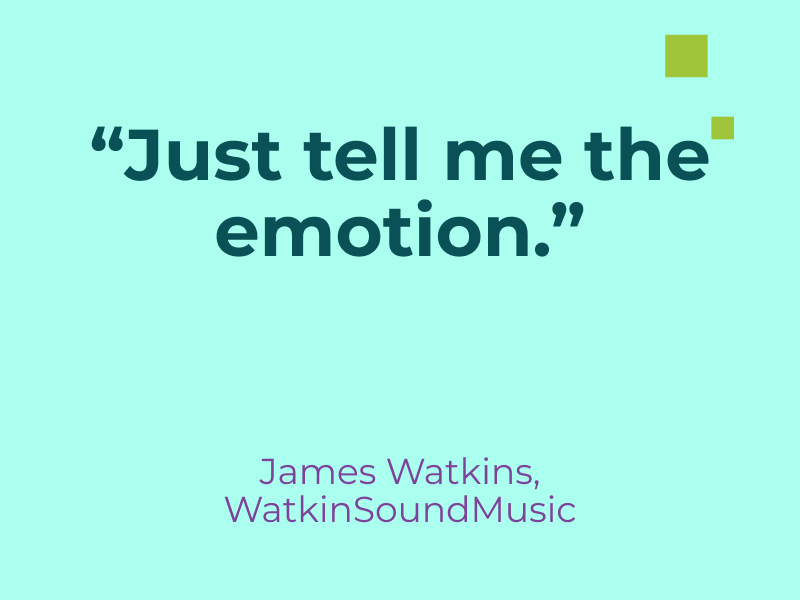
Just tell me the emotion.
That is not dumbing the work down. It is making the brief usable. A composer can translate the feeling into palette, rhythm, density, instrumentation, and theme. A science fiction game might call for synthesizers and designed textures. A horror game might need open space, uneasy tones, and sound pushed out to the sides so effects still have room in the middle.
The lesson for small teams: do not wait until the end and ask for “music.” Decide what each moment is supposed to do to the player.
A Loop Is Not Enough
James showed one Wwise-style approach built from multiple intensity layers. Low. Medium. High. Confrontation. Release.
The track may only be 45 or 60 seconds long, but the experience is not supposed to feel like a 60-second loop. It reacts to game calls: enemy sees player, player moves closer, battle begins, player leaves the perimeter, enemy gains the upper hand.

That is the difference between a soundtrack and a living score.
He also walked through a more vertical writing approach, where several layers each contain multiple variations. Every time the music loops, the system can choose a different combination. James compared it to rolling dice: four layers, multiple variations, and a different result each pass.
For gameplay, that matters because players are not following a linear timeline. They might stay in one area for ten seconds. Or twelve minutes. The music has to survive both.
Unreal Can Carry More Than People Think
Wwise and FMOD came up as the familiar audio middleware options. James called them the Coke and Pepsi of the space, which got the point across quickly.
But he also spent time on Unreal.
Unreal’s audio engine, in his view, has become strong enough that a team can build an interactive music system directly inside it. It does not arrive with every Wwise-style music feature ready to go, but the pieces are powerful enough to mimic a lot of that behaviour if someone understands the structure.
For his work on Nephilim: A Path of Vice and Virtue, James built a system in Unreal that could handle interactive music without pulling the whole project into a separate middleware workflow.
His practical rule there was refreshingly blunt: keep it simple where you can. Complexity is easy to add. Smoothness is harder.

The Short List
- Name the emotional purpose of each scene before asking for music.
- Give the composer gameplay states, not vague references.
- Plan intensity changes around game calls.
- Write short music ideas so they can combine without clashing.
- Leave room in the frequency range for sound effects and voice.
- Test the music in-engine, not only in the audio workstation.
- Iterate until the transition feels invisible.
What to Keep in Mind
Fifteen people came out for this session to listen to James give a great technical presentation.
Nothing was abstract. James showed how a score can change when a player moves, how a melody can tail off without feeling chopped, and how a composer can work like a teammate inside the production branch instead of handing over finished tracks from the outside.
That is a real gap for indie teams. Audio is often treated as late-stage polish, even though it shapes the player’s sense of space, threat, pace, and reward from the first minute.
If you missed it, materials will be available to Associate members through the OGDA member portal.
What’s Next?
Our next Level Up Talk is on August 6, 2026, with Tina Merry and Carina Kom from Simply Sweet Games.
They will be talking about How to Pitch, which should be useful for anyone trying to explain their game clearly to partners, publishers, funders, collaborators, or the people they hope will care about it.
Watch ogda.ca and the OGDA Discord for the event details.
In the meantime, this was a good reminder that OGDA’s education lane does not have to live only in code, art, business, or publishing. Game audio is craft too. And for a lot of solo developers, it may be the half of the game they have been quietly shipping blind.