

Getting funded can be the thing that sinks a studio. That was James Smith‘s argument at OGDA’s October Level Up Talk, and he sees the aftermath in his day job. A publisher signs, a clip goes viral, and a team built for a slower pace is suddenly running flat out with no map. His answer is operations, the unglamorous structure that keeps the game, the team and the studio upright once momentum shows up.

James is CEO of BlackCap Creative, the Kelowna studio he founded, and spends much of his working life as a game triage specialist: the outside partner a studio calls once a project has gone sideways. He is one of OGDA’s founders and co-hosts the Indie Innovators podcast, a show about building games and the studios behind them. He had already given this talk at Forge in Vancouver. His work includes games outsourcing and mentorship, with the practical aim of helping studios keep making games.
Buy-In Is the Trap
August’s Level Up Talk was about how to pitch. This one asked the next question: what if the pitch works?
Most projects follow the same curve, James said. Prototype, craft, and then a spike he calls buy-in. Funding lands. A publisher bites. A clip goes viral and the community gets loud. Everyone reads that spike as the win.
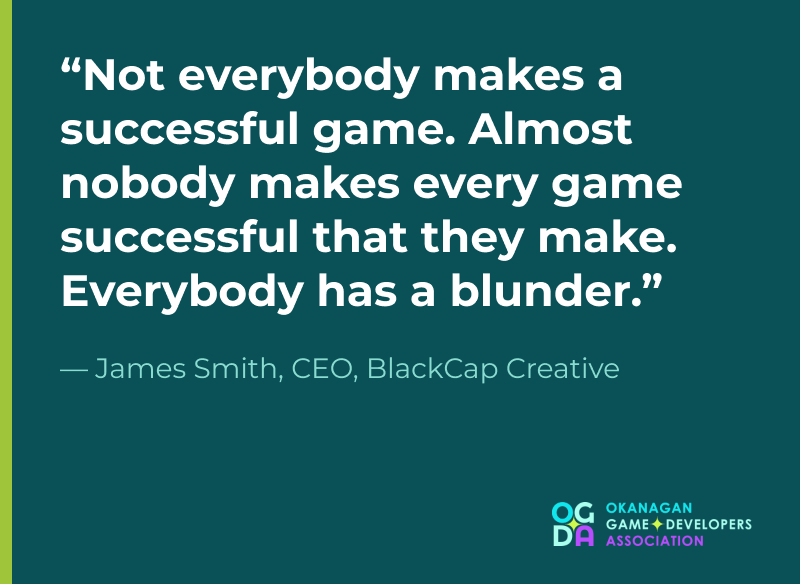
He reads it as the trap. Momentum arrives before launch, and the studio is not built to carry it, so projections drift and plans stop matching anything real. His analogy was hard to argue with: “you planned to walk there and now you gotta drive,” on streets whose names you never learned.
He has a name for it: unmanaged momentum. The success hits before the game ships, the team was never set up to handle it, and the plan turns into what he called “just a big mess.”
He split the fix into three pillars: the game, the team, and the studio.
Pillar One: If It Breaks the Frame, Cut It
James reckons ninety percent of the indie developers he has met just want to build a game. That’s fine, he said. But if that is all you focus on, that is all you get.
For the game itself, he had a test for scope creep that fits on a sticky note. A new feature or mechanic turns up. Does it require rebuilding your current framework (new interfaces, new systems, a physics plugin so a character’s outfit can wobble)? If it drops into your existing scripts, great, in it goes. If it needs extra work, you don’t build it. It goes to the next game, or the wish list, where it will quietly stay.

Scoping for volume means making room for admin: tickets, reports, emails and acknowledgements. His advice was blunt. “Automate all the boring stuff because nobody’s gonna do it anyways.” A daily script that checks who’s behind and pings them does a lot of a project manager’s nagging for free.
Pillar Two: Lanes Turn Into Bottlenecks
The team pillar started with a picture most studios will recognize. A group of specialists, each trusted to do one thing. The artist does art, the coder codes, nobody bothers anybody. It works right up until someone is out. Hurt, distracted, unavailable. Then the whole thing stalls, and as James pointed out, momentum does not slow down to wait.
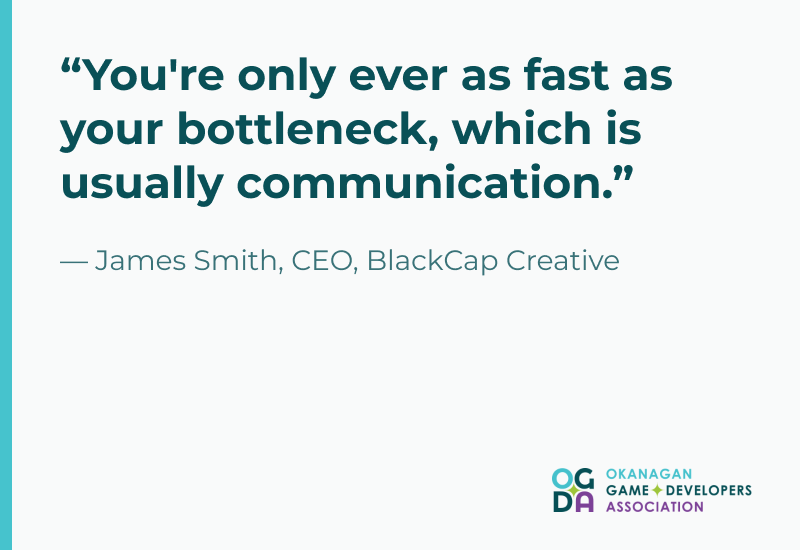
In the projects he consults on, the pattern is decision paralysis. People usually know how to fix the problem. They don’t touch it, because now “it’s their name on the commit” (the saved code change), so the bug sits until someone formally assigns it. His fix is shared operational knowledge: a web of overlapping responsibility, easier on small teams, where nobody has to wait for the technical director to come back.
In Q&A, he described another bottleneck: with visual scripting assets such as Unreal’s Blueprints, one teammate can lock a file for editing and leave everyone else waiting.
Pillar Three: Wear Both Hats
The studio pillar, James said, is the one nobody does. Visibility is the creative side: relying on a great demo and figuring the rest out later. Most games fail because their marketing failed, he argued, usually because nobody thought about marketing until release, and then the two-month launch window went to bug reports.
Viability is the business side. Schedules, contracts, software, space, and a repeatable execution engine, so the next game doesn’t mean reinventing everything (or switching engines). Investors and publishers care about exactly this. “What they’re actually investing in, is your team’s ability to execute and the likelihood of you being able to do it again.”
You need both hats. When someone asked in Q&A how many months before release to start marketing, he answered with a question.
Tone, verbs, hashtags, studio voice: all of it can start in a Word document during your first development cycles. A basic landing page, a community invite and a newsletter sign-up are enough to begin.
Counter question, why aren't you marketing it now?
— James Smith, BlackCap Creative
Things to Keep in Mind
- Cut any feature that forces you to rebuild your framework. Park it for the next game.
- Automate the admin nobody wants to do, starting with a daily “who’s behind?” check.
- Share operational knowledge so one missing teammate doesn’t stop the build.
- Split big scripts into modules so two people aren’t waiting on one file.
- Start your marketing thinking in the first few development cycles, not the last few weeks.
- Record playtests on your phone. Hands on a controller are fine for a clip; leave faces out.
- Look at HacknPlan if Jira is wearing on you. It has a free tier, and James rates it for indie teams.
- Get your studio onto MeetToMatch, the games-industry meeting platform where James says publishers now send everyone.
Participation Is the Part You Control
James closed on community, and on intention. Joining a Discord and lurking doesn’t count. You get what you put in: share the work in progress, ask the silly question, show up. When a game stumbles, it’s the brand, the community and the team around you that carry you through.
The Q&A ran long enough that James admitted he’d talk all night if we let him. As one of our OGDA EiRs, If you would like to arrange a 1:1 session to get his opinion on issues you’ve run into, become an Associate member. Through our Associate member portal, you will be able to request meetings with our network of EiR’s
November 5th: Sen-Foong Lim
Our next Level Up Talk is Game Design Hurdles and Pitfalls with Sen-Foong Lim, on Thursday, November 5th, 18:30 to 21:00 at Accelerate Okanagan (#201 – 460 Doyle Avenue) and online.
Sen-Foong designs board games and roleplaying games. He co-founded the Tabletop Game Designers Association in 2024 and now serves as vice president. His credits include Belfort and Junk Art with long-time co-designer Jay Cormier, creatures for the Gloomhaven roleplaying game bestiary, and the writing team on the ENnie-winning Avatar Legends: The RPG. He also co-hosts the Ludology podcast.
After a night on keeping a studio alive, a night on the design traps themselves feels like the right next step.
RSVP on Eventbrite. Online details will follow in the OGDA Discord.
Ready to level up with Okanagan game developers?